OmniHubv1.3.3

Fan and power control for Windows laptops

A replacement for Omen Gaming Hub. Fan curve control with a safety floor, GPU power and mode, and AMD CPU tuning — through the same hpqBIntM BIOS interface the vendor's own software uses. Every write is read back; nothing is estimated.

Version
1.3.3
Released
10 Sep 2026
Size
49 MB
Platform
Windows 10/11 x64
Runtime
none (self-contained)
Privileges
Administrator
Licence
MIT
Telemetry
none

Unsigned build — SmartScreen will warn. SHA-256 below.

01The problem: HP firmware 0% fan bug

On some HP Omen and Victus laptops, the Default/Balanced BIOS fan table contains a 0% idle entry that can be reached while the machine is still genuinely hot. The fan stops. Nothing brings it back until the next threshold is crossed, and the heat has nowhere to go in the meantime.

OmniHub's Auto (Curve) mode adds a floor: past a temperature you choose, 0% stops being a value the curve is permitted to return, whatever the stock table asks for. The curve is re-applied every two seconds, because the firmware does not stop trying.

The floor holds only while OmniHub is running. Closed, crashed, or not yet started after a reboot, the laptop is back on the stock curve. Enable Launch when you sign in so the protection is the default rather than something you remember.
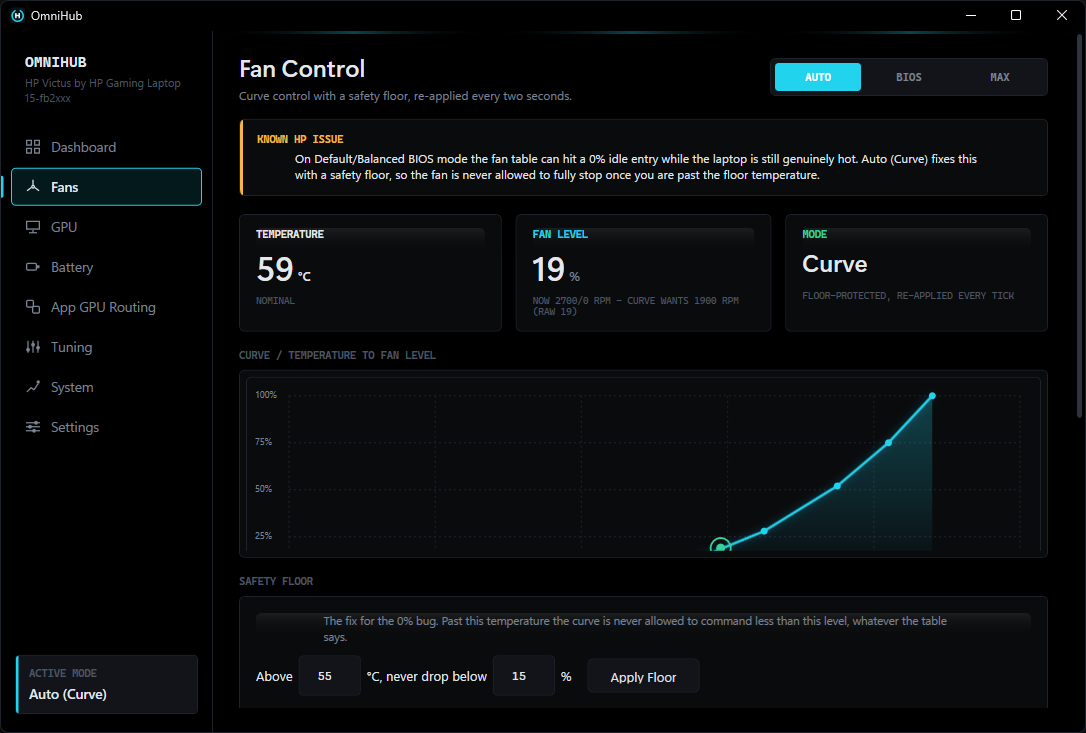
OmniHub's Fans tab, showing a notice about the 0% idle entry, live temperature 59 °C and fan level 19%, an editable temperature-to-fan-level curve, and a safety floor configured to never drop below 15% above 55 °C.
Fans tab. The floor is two fields and a button — above 55 °C, never drop below 15%. Note the fan line: now 2700/0 RPM — curve wants 1900 RPM (RAW 19). Commanded and actual are separate fields because they disagree, and a single merged number would hide a fan that has stopped responding.

02What it does

Six areas of control, and one rule running through all of them: a value the hardware did not report is shown as unavailable, never as a plausible number standing in for it.

Each area is enabled by what the machine answers, not by what this page claims. See Compatibility below.
AreaWhat you get
FansAn editable temperature-to-level curve, a safety floor that overrides the stock 0 % entry, a manual calibration sweep to find your own chassis’s raw band, and a Max mode.
GPU powerCustom TGP and Dynamic Boost as separate switches, GPU mode, and the ceiling re-asserted on a timer because the firmware takes it back.
CPU tuningSustained and boost power limits, thermal limit, and a per-knob enable, so a limit you have not set is never written.
Adaptive tuningMoves the sustained power limit within a range you set, steering on temperature and demand together.
MeasurementA repeatable load test with saved runs, the five-way bottleneck table, per-phase poll timing, and a thermal log.
WindowsPower plans, timer resolution, MMCSS, process priority, and per-application GPU routing.

Adaptive tuning steers on demand, not on heat alone

A controller watching temperature by itself has a failure mode that reads as success: an idle machine is cool, so the limit goes up, which is harmless right up until the limit is high enough that the idle machine warms to the target and stays there. The temperature reading says the controller is working. Version 1.1.0 shipped exactly that.

The direction is now a function of three things — package temperature, the limit in force, and how much the processor is actually drawing against it. A cool machine that is not asking for power gets none, because there is nothing there to give it.

One heatpipe, two chips

CPU and GPU are cooled by the same heatpipe but were tuned as independent knobs, so a GPU-bound game left the CPU holding a sustained limit it was not using while the package sat at its thermal target. The CPU yields when the GPU is busy and the package has reached target. Both conditions are required — a busy GPU on a cool machine is not competing for anything.

The load test exists because a release was wrong

Version 1.1.1 compiled, passed every test, and stopped its own adaptive controller within seconds of launch. Nothing in the application could tell you that, and a ninety-second look at the temperature readout could not either. The Diagnostics tab pins every core for a duration you choose and records temperature, package power, CPU clock and fan speed, then reports median, p90, max and the clock floor — the figure that moves when sustained behaviour does. Runs are saved to disk, so two builds can be compared instead of described.

The load test only reads. No fan commands and no power writes, so it is safe to run while OmniHub is driving the fans — which is the only condition under which its numbers mean anything. Also available headless as OmniHub.exe -LoadTest <minutes>.

What is limiting the processor

Five constraints, each as a fraction of its own limit: sustained power, boost power, EDC, TDC and temperature. Sitting at 99 % of core current and 60 % of power says plainly that raising the power limit will change nothing — which no single figure on the page could say. Without an SMU the whole table is hidden rather than filled in with an estimate.
03Compatibility

OmniHub starts and runs on any Windows laptop. What it can drive depends on the interfaces your machine exposes. Controls the hardware cannot support are disabled and named, never left live and silently ignored.

Your hardware
Status updates with the selection above. These are the same availability rules the application applies at runtime.
CapabilityRequiresStatus
Temperature, load, clocks, memory, battery healthACPI + WMI✓ Supported
Power plans, scheduling, MMCSS, timer resolution, process priorityWindows✓ Supported
GPU name and 3D utilisationWin32_VideoController + engine counters✓ Supported
GPU temperature, power draw, clocknvidia-smi (NVIDIA driver)✓ Supported
CPU power limits, thermal limit, curve optimizerAMD SMU via PawnIO driver⚠ Requires PawnIO
Fan curve, safety floor, GPU TGP unlock, BIOS power limitsHP hpqBIntM✓ Supported

Why other vendors are not supported

Lenovo, Dell and ASUS each expose a completely different ACPI/WMI interface, and there is no cross-vendor standard. None ships unverified, because untested code that writes to unknown ACPI methods on someone else's laptop should not exist.

This page used to say the vendor layer sat behind a single availability check so another backend could slot in beside the HP one. That was half true, and the false half was the one that mattered. What is isolated is the vendor failure — one honest check, and a machine that degrades to a monitor instead of crashing, which is real and is what the table above describes. The implementation was not isolated: there was no interface at the hardware boundary anywhere in the code, so a second vendor was a refactor before it was an addition. Correcting that is under way in the repository and is not in this download.

04The application

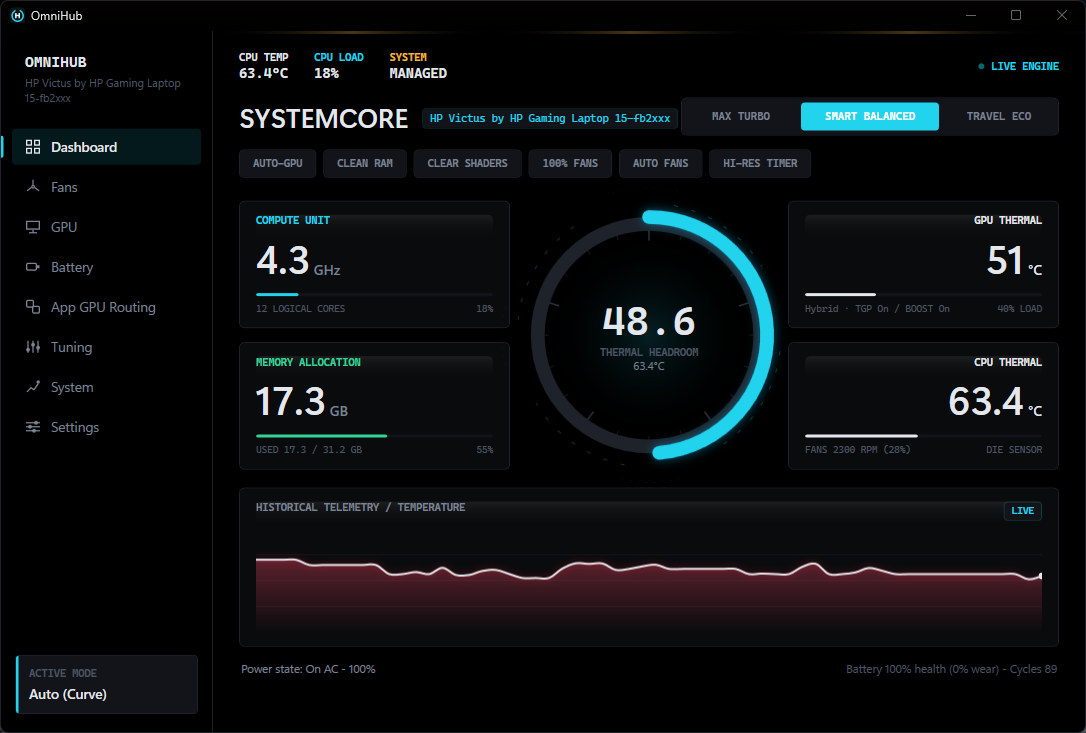
Captured on 1.1.0, on the machine every measurement in the next section came from. The sidebar was regrouped in 1.2.0 — nine destinations became seven — so the navigation differs from the current build. The readouts do not.

OmniHub's Dashboard: CPU 63.4 °C at 18% load, 4.3 GHz across 12 logical cores, 17.3 of 31.2 GB memory used, GPU thermal 51 °C with TGP and Boost on, a thermal headroom gauge, and a live temperature history chart.
Dashboard. CPU die and GPU temperature are separate readouts — one figure for a machine with two heat sources hides whichever is cooler. Hybrid · TGP On / BOOST On is read back from the BIOS, not assumed from what was last written; those are the two flags the power ceiling table below is about.

05Measured results

What came back when the tool talked to firmware — including where the firmware fought it.

Measured on one machine: HP Victus 15-fb2999ax, Ryzen 5 8645HS, RTX 4060 Laptop. Not a fleet and not a benchmark suite. Different silicon and BIOS will answer differently — which is why the application reads every value back instead of assuming a write landed.
MeasurementResult
Average die temperature, SMU thermal limit 85 °C → 80 °C82.8 → 72 °C
GPU ceiling, Custom TGP + Dynamic Boost both enabled60 → 75 W
Time before firmware silently reverts the power unlock≈ 90 s
Unlock retained by a 5 s re-assert6 / 8 samples
OmniHub's own CPU use0.3 – 1.1 %
Resident memory≈ 200 MB
Launch to first hardware reading2.45 s

GPU power ceiling

HP exposes Custom TGP and Dynamic Boost as two undocumented switches. Sweeping all four combinations and reading sustained power back gives +5 W and +10 W respectively — and they stack. Reaching the card's 75 W maximum requires both.

RTX 4060 Laptop under sustained load, read back from the BIOS rather than requested.
Custom TGPDynamic BoostSustained
offoff60 W
onoff65 W
offon70 W
onon75 W

06Interfaces

No abstraction invented for a landing page. These are the same interfaces OmenMon, OmenCore and Omen Gaming Hub itself use.

SubsystemDetail
BIOS controlroot\wmi · hpqBIntM · ACPI\PNP0C14\0_0
Fan level encodingraw × 100 = RPM; measured band 10–56 on board 8C2F
Per-model fan bandprofiles\<baseboard>.json
Load-test runs%AppData%\OmniHub\logs\loadtest-*.csv
Tachometer readbacknot exposed by this interface
Die temperatureTHM_TCON_CUR_TMP 0x00059800 · 0.125 °C
Ring-0 accessPawnIO (signed, optional)
Settings%AppData%\OmniHub\settings.json

Verifying an unchecked laptop

Before trusting curve control on a model nobody has confirmed, run the probe from an elevated terminal. It prints what the BIOS returns with nothing interpreted on top.

# elevated terminal
OmniHub.exe -Probe

=== OmniHub Hardware Probe ===
Manufacturer    
Product         
Baseboard       
Fan count       
Fan types       … hex bytes
Fan levels      … hex bytes
Fan table (32B) … hex bytes
Temperature     … C (via ACPI thermal zones, not hpqBIntM)
Max fan active  
Throttling      
GPU mode        
GPU power       

Field layout only — the values are whatever your BIOS returns, and no sample output is reproduced here because a plausible-looking one would be indistinguishable from an invented one.

What it will not report

07Install

Windows will warn about this download. The build is not code-signed, so SmartScreen shows "Windows protected your PC". That warning means Microsoft has not seen the file vouched for — not that it has been inspected and cleared. Verifying the checksum proves the file arrived intact; it does not tell you to trust it. Building from source settles both.

SHA-256 of OmniHub-1.3.3-setup.exe, built from commit b9fa0f5:

f503166eadc7b585a11c53842740c75a9f8b0680dca2d345b3397273e886f5c7

Get-FileHash .\OmniHub-1.3.3-setup.exe -Algorithm SHA256

This checksum is written by hand at release time and belongs to the version named above. Every release publishes its own on its release page, which is the one to check against if the download button has since moved to a newer build.

  1. Run OmniHub-1.3.3-setup.exe and accept the UAC prompt. Elevation is not optional — the WMI session requires it, the SMU driver refuses unelevated callers, and the install directory sits under Program Files.
  2. Agree to the licence and choose where it goes. The default is C:\Program Files\OmniHub.
  3. Tick what you want: a desktop shortcut; Start OmniHub when I sign in, which registers a scheduled task that runs it elevated without a prompt at every login; and the PawnIO driver, fetched through winget from its own publisher rather than bundled here. PawnIO is needed only for the Tuning tab — everything else works without it.
  4. Finish. Setup offers to launch it, and it lives in the system tray.

If OmniHub is already running, setup stops and asks you to close it rather than closing it itself. That is deliberate: exiting through the tray hands fan control back to the BIOS, and a process killed to free a file lock never reaches that path — it can leave the fans pinned at whatever level was last commanded. Uninstalling removes the sign-in task as well as the files.

Build from source

winget install Microsoft.DotNet.SDK.10
git clone https://github.com/Vomitted/OmniHub.git
cd OmniHub
dotnet build OmniHub.slnx -c Release

Install the current SDK, not 8.0 — the solution uses the newer .slnx format the .NET 8 SDK cannot parse. It still builds the net8.0 target.

Updating

The application checks for new releases itself: Settings → Updates shows the installed version, the notes for anything newer, and downloads it with progress. It stops at revealing the file rather than unpacking over the running install — OmniHub holds the fan service and runs elevated, and replacing its own binary underneath itself to save one manual extract is not a trade worth making here.

08Changelog

Read live from the published releases, which is the same list the application's Settings tab reads. There is no separate feed to fall out of date. Full history in CHANGELOG.md.

Loading releases…

Not in this download

105 commits have landed on main since 1.3.3 was published on 10 September, and no release has been cut from them. The button at the top of this page does not have any of it. It is listed here so the download is not credited with work it does not contain.

The full list is under [Unreleased] in CHANGELOG.md, including one feature measured and deliberately not built.

09Known limitations